
A complete business plan for a flower shop is a seven-part roadmap that defines your target market, projects revenue and expenses, outlines marketing strategies, and demonstrates to lenders or investors exactly how your floristry business will become profitable. For Canadian florists entering a market worth over $1.2 billion annually, this document transforms a creative passion into a financially viable enterprise by addressing operational logistics, competitive positioning, and cash flow management specific to perishable inventory.
The difference between flower shops that thrive and those that close within two years often comes down to planning. Without a formal business plan, you’re navigating critical decisions about location, inventory investment, and pricing structure on instinct alone. Lenders reviewing dozens of applications weekly can immediately distinguish entrepreneurs who understand their cost of goods sold, break-even point, and customer acquisition strategy from those who haven’t quantified their vision.
This guide walks you through each essential component, from conducting competitor analysis in your local market to building realistic financial statements that account for Valentine’s Day spikes and summer slowdowns. Whether you’re seeking a small business loan, pitching to investors, or simply validating your concept before signing a lease, you’ll learn to present your flower shop as the calculated business opportunity it can be. We’ll also connect you with mentorship resources designed specifically for Canadian florists launching their first retail venture.
What You’ll Need to Create Your Flower Shop Business Plan
Before you write a single word of your business plan, gather the right tools and information. Walking into this process unprepared wastes time and produces a document that won’t convince investors or guide your operations effectively.
You’ll need reliable market research on the Canadian floristry industry. This includes consumer spending patterns, seasonal demand fluctuations in your province, and demographic data for your target area. Statistics Canada provides free census data that reveals household income levels, population density, and age distributions, all critical for understanding your potential customer base. Local chambers of commerce often publish retail spending reports specific to your region.
Financial planning requires templates and benchmarks. Download a business plan financial template that includes startup cost worksheets, monthly expense trackers, profit-and-loss projections, and cash flow statements. You’ll need industry-specific numbers: average revenue per transaction for Canadian flower shops typically ranges from $45 to $75, while wholesale flower costs run 30-40% of retail prices. Rent expectations, utility costs, and labour rates vary significantly between urban centres like Toronto and smaller communities, so gather local commercial real estate listings and wage surveys.
Essential resources for your planning process include:
- Business plan template (SBA Canada or CFDC templates work well for floristry ventures)
- Competitor analysis spreadsheet to track local flower shops’ offerings, pricing, and market positioning
- Supplier contact list with wholesale pricing from at least three Canadian flower distributors
- Access to industry associations like Flowers Canada or provincial floristry groups for benchmarking data
- Accounting software trial (QuickBooks, FreshBooks, or Wave) to model financial scenarios
- Mentorship or professional guidance from experienced florists who understand Canadian market realities
If you’re new to the industry, floristry course selection becomes part of your preparation, formal training adds credibility to your business plan and fills knowledge gaps about design techniques, inventory management, and customer service standards that investors will question.
Set aside 20-30 hours for thorough research before you start writing. The quality of your inputs determines the credibility of your finished plan.
Important Considerations Before You Start

Before you invest time drafting a business plan, assess whether you’re genuinely prepared for the financial and operational realities of running a flower shop. Many aspiring florists underestimate startup costs, refrigeration units, walk-in coolers, delivery vehicles, and initial inventory can easily exceed $50,000 before you open your doors. Beyond capital, consider whether you can sustain yourself during the ramp-up period. Most flower shops take 12 to 18 months to reach profitability, and you’ll need working capital to cover rent, utilities, and perishable inventory while building your customer base. If you’re relying on florist work as your primary income, research the realistic florist salary in Canada to ensure your projections align with industry norms.
Market saturation poses another critical risk, particularly in urban centres where established florists already hold customer loyalty and preferred vendor relationships with event planners. Survey your local area honestly: can the market support another shop, or will you need a distinct specialty to carve out your niche? On the regulatory front, familiarize yourself with provincial business licensing, food handling requirements if you offer edible arrangements, and zoning restrictions that may limit retail or delivery operations from certain locations. Finally, recognize the commitment required. Flower shop ownership means predawn trips to wholesalers, physically demanding design work, weekend weddings, and holiday rushes that consume Valentine’s Day and Mother’s Day entirely. If these realities don’t deter you, you’re ready to build a plan that accounts for them.
Step-by-Step: Building Your Flower Shop Business Plan
Executive Summary: Your Flower Shop at a Glance
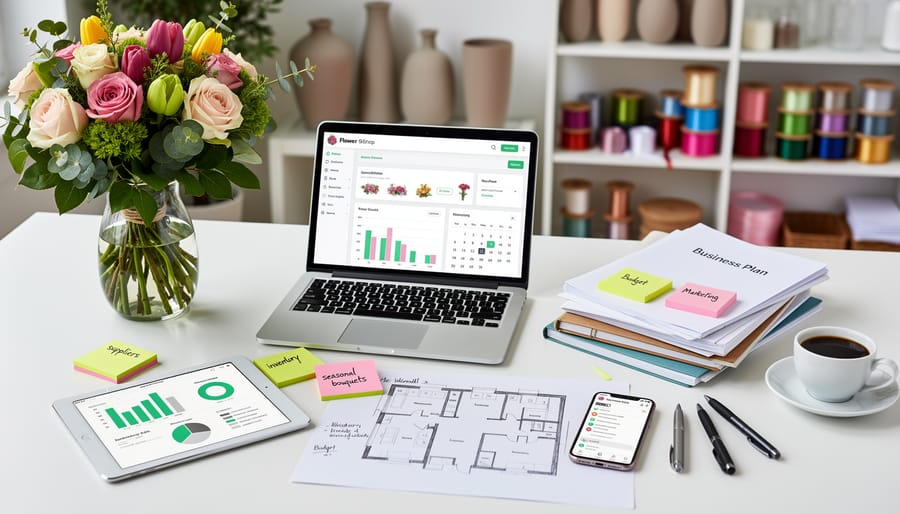
Your executive summary is the first thing investors and lenders will read, so it needs to hook them immediately with your flower shop’s core promise and viability. This isn’t a teaser, it’s a condensed version of your entire plan that stands alone, typically one to two pages maximum.
Start with your shop’s name, location, and what makes you different. Are you offering same-day delivery in an underserved neighbourhood? Specializing in sustainable, locally-grown blooms? Focusing on high-end wedding work? State this clearly in the opening paragraph.
Next, include your mission statement and target market. Who are your ideal customers, and why will they choose you over established competitors? Follow with a snapshot of your financial ask and projections: how much funding you need, what you’ll use it for, and your expected revenue in years one through three. Investors want to see realistic numbers that show you understand flower shop economics, average transaction values, seasonal fluctuations, and operating margins.
Close with your qualifications and competitive edge. Mention relevant experience, investor-ready training or industry connections that reduce your risk of failure. Write this section last, after completing your full plan, so you can distill the strongest points accurately.
Company Description and Structure
Your company description tells investors exactly what your flower shop will do, how it will operate, and why customers will choose you over competitors. Start by stating your business name, location, and primary services, are you focusing on retail walk-ins, wedding and event work, corporate accounts, or a combination?
Next, define your legal structure. Most new flower shops begin as sole proprietorships for simplicity and lower startup costs, but this means unlimited personal liability. Incorporating offers liability protection and potential tax advantages once you’re established, though it requires more paperwork and accounting costs. Consider consulting an accountant familiar with small Canadian retail businesses before deciding.
Location strategy matters enormously in floristry. Will you operate from a street-level storefront in a high-traffic area, a home-based studio focusing on delivery and events, or a hybrid model? Each affects your costs, customer reach, and business operations differently.
What makes your shop unique? Perhaps you specialize in locally-grown Canadian flowers, sustainable practices, a specific design aesthetic, or serve an underserved community. This differentiation should connect directly to the market gaps you identified in your analysis and give investors confidence you’ve carved out a defensible position.
Market Analysis for Your Local Floristry Niche
Understanding your local market is where your business plan moves from theory to reality. Investors want proof you know who’ll buy from you and why they’ll choose your shop over competitors.
Start with customer demographics in your specific area. Are you near residential neighborhoods with young families, downtown offices planning corporate events, or retirement communities? Use census data from Statistics Canada to identify age ranges, household incomes, and population growth trends. A shop in Vancouver’s Kitsilano serves different needs than one in suburban Mississauga or rural Nova Scotia.
Map your direct competitors within a 5-kilometer radius. Visit their shops, check their websites, and note their pricing, specialties, and gaps. If three competitors focus on weddings but nobody offers same-day delivery for last-minute occasions, you’ve found your opening.
Document seasonal patterns specific to Canadian floristry. Valentine’s Day, Mother’s Day, and Christmas drive 40-50% of annual revenue for most shops. But regional events matter too, Stampede season in Calgary, tulip festivals in Ottawa, or local farmers’ markets create unique opportunities.
Research wholesale flower availability in your region. Western provinces access different growing regions than Atlantic Canada, affecting what you can source fresh year-round versus seasonally.
Present this data clearly: one paragraph on target customers, one on competitive landscape, and one on market opportunities. Include a simple competitor comparison table showing how you’ll differentiate. Numbers and specifics convince investors you’ve done your homework.
Services, Products, and Your Floristry Specialty
Your product and service lineup defines how you’ll compete and profit. Start with your core offerings, everyday fresh bouquets, seasonal arrangements, and plant sales. Many successful Canadian shops build around budget-friendly plant options and fast-growing annuals that appeal to home gardeners, creating steady revenue between event bookings.
Then detail your specialty services. Will you focus on weddings, corporate contracts, sympathy work, or subscription deliveries? Each has different margins and operational demands. Wedding work brings higher ticket sales but requires consultations and weekend labour. Corporate accounts offer predictable income with lower per-order profits.
Position your pricing clearly. Research what competitors charge for similar products, then justify where you sit in that range. Premium pricing requires superior design skills, rare blooms, or exceptional service. Value positioning needs volume and efficiency.
Explain your sourcing strategy too. Local growers, wholesale markets, and direct imports each affect your costs, freshness guarantees, and sustainability claims. Investors want to know your supply chain makes financial sense year-round, especially through Canadian winters when local inventory drops and costs spike.
Marketing and Customer Acquisition Strategy

Your marketing strategy proves to investors that you understand how to attract and keep customers in 2026’s competitive floral market. Start with your digital foundation: outline your website functionality (online ordering, delivery options, portfolio gallery), social media platforms where your target customers spend time, and your content calendar for Instagram or Facebook. Specify whether you’ll invest in professional photography, paid ads, or SEO to drive traffic.
Detail your local presence tactics. Will you partner with wedding planners, event venues, corporate offices, or funeral homes for referrals? List specific outreach plans, such as attending bridal shows, joining your chamber of commerce, or supplying arrangements to local businesses on subscription. These partnerships create steady revenue streams that impress lenders.
Address seasonal promotions explicitly. Flower shops see predictable peaks (Valentine’s Day, Mother’s Day, wedding season from May through September) and slower periods. Explain how you’ll capitalize on high-demand holidays with pre-order campaigns and navigate quiet months with workshops, subscription boxes, or corporate contracts.
Customer retention matters more than many florists realize. Describe your loyalty program, email marketing for birthdays and anniversaries, or subscription services that generate recurring revenue. Show you’ve planned beyond the first sale to build lasting relationships.
Finally, set measurable goals. Instead of “increase social media presence,” write “gain 500 Instagram followers in year one through three posts weekly and local hashtag engagement.” Concrete metrics demonstrate you’ll track what works and adjust accordingly.
Financial Projections and Startup Costs

A Canadian flower shop typically requires $50,000 to $150,000 in startup capital, depending on location and scale. Your business plan must break down exactly where every dollar goes and when you’ll recover it.
Start with one-time startup costs: lease deposits and improvements ($10,000, $40,000), coolers and display equipment ($8,000, $25,000), initial inventory ($3,000, $8,000), point-of-sale systems ($1,500, $3,000), signage and branding ($2,000, $5,000), and licenses and insurance ($1,500, $3,000). Don’t underestimate the renovation costs, most retail spaces need significant work to accommodate refrigeration and water access.
Your operating expenses spreadsheet should project monthly costs over at least 24 months: rent, utilities, inventory replenishment (typically 25-35% of revenue), labour (owner salary plus any staff), marketing, loan payments, and a contingency buffer of 10-15%. Be honest about seasonal fluctuations, February and May will carry you through slower summer months in most Canadian markets.
Revenue projections need realistic assumptions. A small shop might average 15-30 transactions daily at $45, $75 per sale, with wedding and event work adding larger but less predictable income. Build three scenarios: conservative, moderate, and optimistic.
Your break-even analysis shows investors when you’ll stop losing money, typically 12-18 months for flower shops. Cash flow statements reveal whether you can actually pay bills during lean periods, which matters more than annual profitability when you’re starting out.
Funding Requirements and Use of Funds
Start with the total amount you need to launch and operate your flower shop for at least the first year. Break this number down into specific categories: initial inventory, cooler and equipment purchases, lease deposits, renovation costs, marketing budget, and working capital reserves. Investors want to see exactly where their money goes.
List each expense with a realistic figure. For example, a refrigerated floral cooler might cost $3,000-$8,000, while initial flower inventory could require $2,000-$5,000. Include permits, insurance, and a cushion for unexpected costs. Be honest about your needs rather than lowballing to appear conservative.
Identify your funding sources clearly. Canadian florists can explore small business loans from major banks, credit unions, and Community Futures Development Corporations. The Canada Small Business Financing Program helps secure loans up to $1 million. Many provinces offer grants for new businesses, particularly for women entrepreneurs or rural ventures.
State what you’re contributing personally and what you’re seeking from external sources. If you need $50,000 total and have $15,000 saved, say so. This shows commitment and reduces perceived risk. Specify whether you’re seeking a loan, investment, or grant, and outline repayment terms if applicable.
Reviewing and Testing Your Business Plan
Once you’ve drafted your business plan, step away for at least 24 hours before reviewing it with fresh eyes. This distance helps you spot gaps, inconsistencies, or sections that assume knowledge your reader won’t have.
Start with a completeness check. Print your plan and read it as if you’re seeing it for the first time. Does every section answer the questions an investor would ask? Are your financial projections backed by clear assumptions? If you’ve claimed your target market is “busy professionals aged 25-45,” does your marketing strategy actually reflect how to reach that demographic?
Next, test your numbers rigorously. Walk through your cash flow projections month by month. Can you genuinely operate on $3,000 in monthly flower inventory if you’re projecting $15,000 in sales? Do your startup costs account for licensing fees, insurance, and the three-month buffer most lenders want to see? If something feels optimistic, it probably is. Adjust it.
Seek feedback from people who understand both business and floristry. Local florists, small business advisors through your regional chamber of commerce, or mentors from floristry associations can spot issues you’ve missed. Present your plan to someone unfamiliar with your vision. If they can’t explain your business model back to you after reading it, your executive summary needs work.
Consider scheduling a mock pitch with a business mentor. Presenting your plan aloud reveals weak spots immediately. You’ll stumble over sections that aren’t clear or defend projections that need more support.
Finally, cross-check that your tone remains consistent and every section supports your central positioning. A plan promising premium wedding floristry shouldn’t detail budget-conscious pricing throughout. Alignment matters as much as accuracy.
Next Steps After Your Plan Is Complete
With your business plan complete, you now have a powerful tool for multiple purposes. First, use it immediately to approach lenders and investors, tailor your presentation to emphasize the financial projections and market analysis sections most relevant to each funding source. Canadian small business loans through banks, credit unions, and government programs like the Canada Small Business Financing Program all require detailed plans, so ensure yours is polished and professionally formatted before submission.
Treat your plan as your operational roadmap during launch. Review it weekly in your first months to track whether you’re meeting milestones, staying within budget, and hitting customer acquisition targets. If you’re setting up retail space with outdoor displays, consider practical infrastructure like economical garden edging to protect flower beds while maintaining curb appeal.
Schedule quarterly reviews to update financial actuals, adjust projections based on real performance, and refine your marketing strategy as you learn what resonates with customers. Your plan should evolve with your business, seasonal trends, supplier relationships, and customer preferences will shift, and your document should reflect those realities.
Strengthen your foundation by exploring additional resources: research commercial flower cooler requirements, investigate floristry certification programs through organizations like the Canadian Institute of Floral Design, and join provincial florist associations for networking and continuing education. These connections provide ongoing mentorship and keep you current with industry standards as your shop grows.
Common Questions About Flower Shop Business Plans
Starting a flower shop business plan often raises practical questions. Here are the answers to the most common concerns aspiring florists face when putting their plan together.
How long should my flower shop business plan be?
A solid business plan typically runs 15-25 pages, including financial statements. Investors want enough detail to understand your concept and numbers, but not so much that key points get buried in unnecessary fluff.
How far ahead should I project my financials?
Most lenders and investors expect three to five years of financial projections for a flower shop. Focus on monthly projections for the first year and quarterly or annual for years two through five, acknowledging the seasonal nature of the floristry business.
Do I need a business plan if I’m not seeking outside funding?
Yes. Even if you’re self-funding, a business plan serves as your operational roadmap, helping you make informed decisions about inventory, staffing, marketing spend, and growth timing. It keeps you accountable to realistic financial targets.
What’s the biggest mistake people make in flower shop business plans?
Underestimating startup costs and overestimating first-year revenue. Many aspiring florists forget to account for slow months, spoilage rates, and the time needed to build a customer base in a competitive local market.
Remember that your business plan isn’t a one-time document. Successful flower shop owners revisit and update their plans quarterly, especially during the first two years of operation. Market conditions shift, customer preferences evolve, and your actual performance will reveal insights you couldn’t have predicted on paper. Treat your plan as a living document that grows with your business, not a static requirement you complete and file away.
If you’re struggling with specific sections or unsure whether your projections are realistic for the Canadian floristry market, reach out to mentors through industry associations or business development centres. Fresh eyes from someone who understands flower shop operations can catch gaps you’ve missed and strengthen your pitch before you present it to investors or lenders.
A well-crafted business plan is more than a document for investors, it’s your roadmap to building a thriving flower shop in Canada’s competitive floristry landscape. By investing the time to research your market, project realistic financials, and articulate your unique vision, you’re not just preparing to secure funding; you’re setting the foundation for sustainable growth and profitability.
Remember, you don’t have to navigate this journey alone. The Canadian floristry community offers valuable mentorship opportunities and educational resources designed to support aspiring entrepreneurs like you. Whether you’re refining your financial projections or exploring specialized training, connecting with experienced florists can provide insights that strengthen both your business plan and your confidence.
Your preparation today determines your success tomorrow. With a solid plan in hand, you’re ready to turn your passion for flowers into a flourishing business.